Tuesday, July 31, 2012

For my Swedish readers: SF-Bokhandeln presenterar Bögskräck!


Ett event som sker nu på Torsdag i Stockholm, där jag och Johan Sundell snackar bögskräck. Ni är hjärtligt välkomna! :) 

Följ med SF-Bokhandeln på en resa genom skräckfilmens historia från ett hbtq-perspektiv, guidad av Fred Andersson och Johan Sundell! Med tydliga exempel och roliga anekdoter visar vi hur homosexualitet och  transpersoner har påverkat och skildrats i en av Hollywoods mest älskade och klassiska genrer.

Tider
to 2 aug 17:00–19:30

Plats
Science Fiction-Bokhandeln (SF-Bokhandeln Gamla stan), Västerlånggatan 48, T-Gamla stan

Pris
Gratis.

Åldersgräns
Ingen.

Tillgänglighet
Saknar ramp vid ingång över ett litet trappsteg, brukar generellt inte vara något problem för rullstolsburna. Mindre toalett finns tillgänglig vid entré. Vid behov finns hjälpsam personal på plats.

Monday, July 30, 2012

The Devil with Seven Faces (1971)


Don't let the giallo-esque title fool you, The Devil with Seven Faces is far from an murder mystery and yeah, I would say it's a completely different genre. The title might fool us, but don't get scared away from this pretty standard but well-made crime-thriller directed by gun-for-hire Osvaldo Civirani. He dabbled in every genre possible, from pepulm to erotic, but I think this was his only adventure into crime. Not a bad little movie either, but I'll get back to why it's bad and why it's not the best movie ever made either.

Carroll Baker is Julie, a normal girl trying to live a normal life - until suddenly several strange men is starting to stalk her, taking photos of her and behaving very badly. Thankfully she has two men to do the protecting, her lawyer Dave (Stephen Boyd) and her new boyfriend Tony (George Hilton). After a while they understand what has happen. Julie's sister Mary is accused to have stolen a million dollar diamond on London and other criminals thinks Julie is Mary! Soon her life is at stake and everyone around her lives more and more dangerous, and only Julie can bring back the diamond from her sister and make the terror stop.... or?

Or? Yeah, that's the key word in most Italian thrillers from the 70's and this is no exception. It actually has a form of giallo-esque atmosphere, which is also helped by the groovy score, but the movie itself is one of those twisty caper/heist-thrillers, but from a different point of view. This is a quite original take and the story more or less works by itself because the set-up and concept is so good.

The best thing with this film is of course the actors. Caroll Baker is always excellent and works fine in the lead as the lady in need, Luciano Pigozzi has a smaller part as a baddie but is always good. George Hilton, maybe a little bit on routine here - remember he made tons and tons of giallos and other crime-related films during the 70's and this was probably just one in the bunch, another paycheck - even if the Amsterdam-location must have been a nice addition to the job. What makes me really happy is the presence of Stephen Boyd. I had no idea he was in the movie and he's nice to see him so relaxed and cool - compared to all the big budget historical extravaganzas he made in Hollywood. He's a splendid actor, VERY underrated and fits good in this form of film. Like so many other former Hollywood actors who got older he did a lot of European movies during this time, but never became that big in Italy.

I wish I had more to say about The Devil with Seven Faces, but I don't. Well, yeah... the reason why it's not the best movie ever made is that everything smells like a gun-for-hire production. There's no personality in the production, like everyone was there to get their pay check and that's it. Even the action scenes, especially the car chase, is very sloppily made and relies mostly on speed-up footage of cars chasing each other, and it NEVER looks good. I can't imagine why they couldn't find another solution, or just spend some more time shooting the scene - angles could help a lot making it look faster and more dangerous. Now it's just point-and-shoot and it's crap.

Still, it's a good little thriller. It will not revolutionize your world and you might even skip it for more important titles, but if you find it cheap and trust my review, give it a try sometime - at least for good old Stephen Boyd's sake.

Sunday, July 29, 2012

Dressed to Kill (1980)


Brian De Palmas controversial thriller might be a bit too mainstream to be included here on the Ninja Dixon blog. The reason why it's here now it's because it's one of my favourite films by De Palma, and that's a hard choice because I love most of what he's done (I tried watch Scarface again recently but had to turn it off because of Al Pacino's shitty acting, but that's a different story and it's better for my safety that I keep quiet about my opinion). Dressed to Kill feels a lot like a Giallo and it's filled with sex and violence. De Palma himself calls it a "dark sexual fantasy", and that's probably the best description of it.

For once I will skip to tell the story, because it's more or less a version of Alfred Hitchcock's Psycho, with some of the same twists - but a lot bloodier and with more sex. De Palma has always been more European in a sense, but mixed with the American way of doing everything a bit too much. This is a marvellous combination and makes Dressed to Kill maybe the ultimate "erotic thriller" ever made, I mean - you have everything from Dario Argento's stylish murders, Hitchcock's shocks and twists and the tackiness of every American musical ever made. What's even more fascinating is how this is a skin flick, an exploitation movie with big stars and big budget. Full frontal nudity, dirty talk and ultra-violence - something you could only see on 42nd street before this hit the big screens. It's not a rip-off, it's a homage to everything De Palma loves.

Originally he wanted to do Cruising and the rumour says he even wrote a script based on that story, but when he couldn't get the rights to Gerald Walker's novel he just took some of the ideas and transferred them to this new script. The result became the second most controversial thriller of 1980, of course after William Friedkin's own version of Cruising. But when Friedkin took a more serious route, De Palma made a full-out gory, sex and over-the-top murder mystery instead - and maybe that was for the best. Because in a "dark sexual fantasy" you have a lot more freedom than in a production that is based on extensive research and real locations and people. One similarity between Cruising and Dressed to Kill is that both directors choose to let different actors play the killer, than the "real" killer. These actors also played other roles in both movies. I like this idea, it's clever and maybe some would say it's a cheat. But hey, everything for suspense and tension yeah? The Italians did this every damn day during the seventies. Another fine detail is that its De Palma-veteran William Finley doing the voice of "Bobbi", in just another way to confuse us - and those who's trying to catch the killer.

Dressed to Kill deals with transsexual issues, in a quite negative twist also - but I personally think the cause for the murders lays in something else than the gender of the killer, like in Psycho - schizophrenia, multiple personalities etc. The movie actually features a clip from The Phil Donahue Show, where journalist and transgender person Nancy Hunt talks about being transsexual. It's the only connection to realism in the whole movie. This interview was also the thing the triggered De Palma to write Dressed to Kill. He did a lot of research on transsexualism and became more and more fascinated by the thing called "gender discomfort", which also caused some discomfort among his friends: "I was at a dinner party, and I asked, quite innocently, 'Wouldn't it be terrific to dress up in women's clothes and go out and see how people related to you? And everyone looked at me like I was a lunatic!" Happy for us De Palma did make his movie on the subject, just not very correct and proper.

I'm probably not the only person who thought about this, but have you noticed the interesting connection between Dressed to Kill, Blow Out and Body Double? Except being very European and Hitchcockian thrillers of course. Blow Out starts with a homage to b-slashers, with POV camera and an unknown assassin going into a house and killing a woman in the shower. The end of Dressed to Kill features a similar sequence, but this time a dream and not a movie-in-a-movie, were the killer through POV breaks into a house and kills a woman in the  shower. Dressed to Kill didn't only upset the trans-community and the women's right organizations, it also gained negative attention because Angie Dickinson used a body double in the infamous shower scene that starts the movie. Something that's actually very visible and I'm sure De Palma somehow wanted to poke fun at this phenomena - and then he makes a movie called Body Double which ends with a humours scene where they need a body double during the making of a corny horror movie.

The circle is closed and the joke's on Brian De Palma, as usual.

Saturday, July 28, 2012

Plot of Fear (1976)


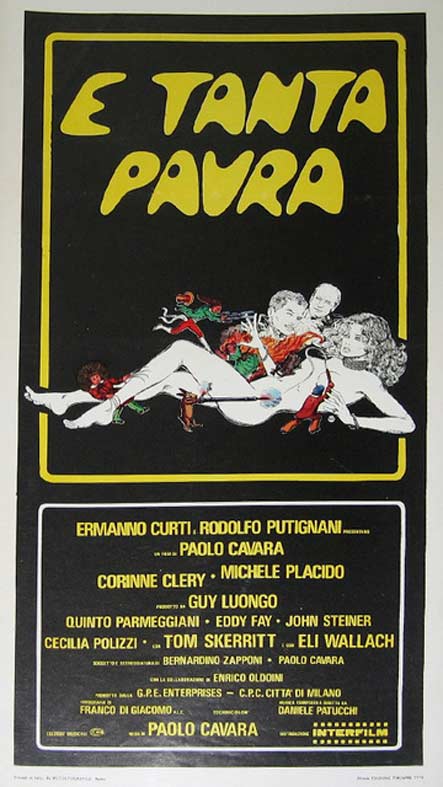
Long time since I watched a giallo, but finally - after a week of Jess Franco - I found the time, early this morning, to sit down and watch Paolo Cavara's very interesting Plot of Fear. My plan was to get my hands on it quiet a while ago when Tom Skerritt visited Stockholm, but I never found it and kinda forgot about it - until yesterday when a the nice DVD from Raro suddenly stared at me from the shelves of a second hand store here in Stockholm. It's mine, I thought and grabbed it faster than The Dark Knight Rises is a fiasco! The only movie by Cavara I've seen before this one is Black Belly of the Tarantula, one of the best giallis ever made. So how could he top that? With making one of the most original and off-beat giallis I've seen.

Michele Placido (more famous from the Italian TV-series La Piovra) is the sexually liberal and slightly odd Inspector Gaspare Lomenzo, a young cop who's know in charge of the investigation of The Fauna Club-murders. One by one the members of this little private sex-club is killed in very various ways and it's impossible to find any clue to who the killer is. Like all good giallis everything is connected to art, and this time to the very macabre (I've read it myself as a child) German children book Der Struwwelpeter, with the killer leaving one drawing from the book at each murder site. Somehow a young woman, Jeanne (Corinne Cléry), knows more than she wants to say - and it doesn't help that Lomenzo falls in love with her, which could be a very bad idea...

That sounds quite ordinary, yeah? Well, it's not. Plot of Fear is an oddity, mostly because it spend so much time just showing us the life's these wonderful characters. It's like Fellini made a low-key, violent, crime movie! Even the smallest part is well-defined and funny, or tragic, and there's a lot of personality in each and every extra in the background. Cavara didn't only create an interesting murder mystery here, but also a colourful gallery of destinies. But fear not, it also has a generous amount of murders - some of them bloody - and a couple of twists and turns.

The flashbacks to the Fauna Club is the best and could be something from a Tinto Brass film. In one interesting sequence they sit and watch an production of the Italian animator Gibba (aka Francesco Maurizio Guido), a very vulgar and sexual detailed cartoon that looks like a mix between sci-fi and fantasy - what can the title be? Let me know if you have any clue! The leader of the Fauna Club is played by John Steiner, an excellent actor doing yet another of his classical sleazebags. What a guy!

Tom Skerritt has a very small part (I wonder how he ended up in this film?) and Eli Wallach a bigger and more interesting part, as a mysterious private detective who some of the Fauna Club-members contact when they realize they might get killed. But I would say that this is Michele Placido and Corinne Cléry's movie, because they rule in every scene they're in.

Plot of Fear is a closeted hippie-giallo with some interesting political undertones and lots of murders. I really loved it. A great thriller, a great drama and a fresh spin on a genre that needs that little extra to be really interesting. 

Eugenie... the Story of Her Journey Into Perversion (1970)


This will be the last film of Jess Franco I will review for a while, mostly because it's hard to find new superlatives for each new text. Franco often revisits same themes and ideas and that makes many of these movies seem a bit similar after a while, so I will end it for this time with another fantastic movie, Eugenie...the Story of Her Journey Into Perversion, as the DVD title says. The original title is Marquis de Sade's 'Philosophy in the Boudoir', based on de Sade's text by the same name, but honestly, both titles works very fine in the end. I have a tendency to prefer Franco's dark sexual dramas before his lighter movies and this is no different. Eugenie is a mature, intelligent drama with lots of nudity and a wonderful cast. The story is as simple as genial...

Marie Liljedahl plays plays Eugenie, the daughter of the rich businessman Mistival (Paul Muller). Mistival's mistress is Madame Saint Ange (Maria Rohm) and she makes him allow her to bring Eugenie to her private island for a weekend. There her perverted stepbrother Mirvel (Jack Taylor) awaits them, and what begins as a childish, drunken and weed-smoking day soon becomes more sinister when a cult worshipping de Sade arrives and watches the Madame and Mirvel sexually use and abuse the young Eugenie...

Being a story based or inspired by de Sade (I never read any of his works) Eugenie is a tasteful trip down sexually lane with some light spanking and whipping, tits and asses, drug use and an intercourse or two. Quite far from the excessive sleaziness Franco shot during the later seventies. This is both good and bad. Good because it gives Franco more time to shoot a stunningly beautiful drama and bad because maybe someone wants more sex when it comes to a movie like this. For me, it doesn't matter. This is high-quality sleaze with some kind of ambition to do more than just give the audience a hard-on.

Eugenie is a trip to one of the circles of hell, an almost supernatural story about living in a world about sex. Franco never says if this is a good or a bad thing, there's not judging at all and the open, almost surreal, ending both reminded me of The Beyond and Nightmare City, if you get my point. It also echoes the later Countess Perverse in style and concept. I would love to have been a fly on the wall on this shoot. First of all we have the cast, the very talented Liljedahl, a Christopher Lee that had no idea (yeah sure!) of what was going on, the producers wife, the wonderful Maria Rohm, making it out with Jack Taylor, a gay man that probably have seen more pussy than few other gay men!

Even today, in 2012, Eugenie, feels very fresh and modern. If it had more gratuitous sex maybe, but still. This is a movie that survived the years and still makes an impact that fits both the cult squad and the arthouse-aficionados. It's interesting how Franco had such a bad reputation from the beginning, because most of his works I've seen is actually quite classy - and they easily would gain more attention than his trashier production if we, the cult movie fans, would demand more of our movies than just boobs, gore and goofy action scenes.

Eugenie... the Story of Her Journey Into Perversion is another masterpiece, yeah, a perfect piece of arthouse-sleaze. 

Friday, July 27, 2012

The Devil Came from Akasava (1971)


First of all, I would lie if I said I actually understood the story of The Devil Came from Akasava, but in some weird way I think that's the point with it all. It's a spoof, a send-up, a caper with a lot of humour and of course made by Jess Franco. Officially another Edgar Wallace story, but I'm not so sure it's really one from the beginning. Maybe something Wallace's son wrote down on a napkin once, just an idea,  a few words and somehow the German producers of got their hands on it. So what's it about? I'll give you the basic structure, but that's all.

Somewhere on a tropical location (really Alicante, Spain and the garden of an hotel) a couple of scientists - Horst Tappert for example - find an amazing stone, or metal, that both create huge damage to the people handling it, but also can transform normal metals into gold - or something like that. Suddenly everyone wants this stone, and one of the scientists goes missing and so is the stone. A relative to the scientist, Rex (Fred Williams), starts to investigate but soon finds out that everyone wants to kill everyone in this confusing mess of a story!

I can't say that The Devil Came from Akasava is Franco's best movie, not by a long-shot, but it still holds a certain charm to entertain me. The best thing with it is the cast, from Horst Tappert doing is normal robotic routine as Horst Tappert to Soledad Miranda, in a quite small part, as a thief and maybe even a secret agent. She's cool and beautiful, as usual! Paul Müller and Howard Vernon shows up later in the story and both is perfect in their small parts. Fred Williams, who was that guy? Anyone who knows? He looks good and had some talent, but he's lost as an interview object. I want to hear his story! Someone, please?

The problem - or maybe the point - is that the script is so damn convoluted. Everyone is fucking up things for everyone else, friends becomes foes and foes becomes friends and in the end... I'm not sure how it ends. This could be a part of the concept of course, the movie has humour and a generous twinkle in the eye. One part I really love is the Kiss Me Deadly-reference, the bag with the mysterious stone that kills people with a strong light. The film could be a unofficial goofy sequel to Robert Aldrich's classic noir-masterpiece...

Franco made this at the same time as Vampyros Lesbos and She Killed in Ecstasy and it differs a lot from the two other movies. It's also one of those Franco films that looks less thought through, cheaper and yeah, sloppier. We have the traditional hotel garden standing in for a jungle, there's editing that even I can do better - sometimes - and uglier lighting. It's easy to see that the heart of Franco wasn't involved all the time, this was a normal gun for hired-project.

Still, quite entertaining and a nice cast. A cozy feeling, a movie to look at when you're very tired and just want to see handsome and cool people walking in and out of hotel rooms doing nothing special.

Thursday, July 26, 2012

Sinner - Diary of a Nymphomaniac (1973)


This starting to sound very repetitive, but Sinner - Diary of a Nymphomaniac is yet another film by Jess Franco that literary stunned me with it's quality. Made for the same producer as Countess Perverse, another fine movie, this Robert de Nesle production is totally opposite when it comes to atmosphere and concept. Countess Perverse is a stylish, comic-book, sleaze-movie and Sinner is another dark, strongly sexual drama that feels very personal. After the death of Soledad Miranda it seems like Franco changed his viewpoint on filmmaking for a couple of years, the stories got more serious and darker, maybe even more depressing, but also a lot more personal.

I don't want to reveal so much about Sinner and how it begins, but it's a brilliant way to start a movie and sets up for a downbeat story about a young girl's descent into a living hell. Linda (Montserrat Prous) arrives to Alicante from a small village, with ponytails and an innocent, childish dress. She drifts around in town until a man starts to follow her, and it ends with him sexually abusing her in a Ferris wheel! Soon after she ends up as the lover of Countess Anna de Monterey (Anne Libert) and her spirals into a mess of sex and drugs... soon she can't take it anymore and plans a revenge on the man that once raped her...

Sinner feels so modern, so fresh. It feels like one of those French indie movies, very arty, but never loosing it's grip around the exploitation parts of the story. The beginning, especially, is among the best I've seen in a Franco movie. One sequence is a loooong take of a man following Linda, handheld camera, in the middle of the unsuspecting crowds. It ends in the Ferris wheel and a beautiful edited sequence that shows nothing - but tells it all. Its rare, I think, to see a morality tale from Uncle Jess, but here it is - the dangers of sex and drugs, without getting annoying or stupid. It's just Franco's way to tell this kind of story.

There's a lot of nudity and sex in Sinner, which doesn't come as a surprise, but I must say that the most impressive thing is the fine performances Franco gotten from his actors this time. It's easy to sleep yourself through a sexploitation movie, but everyone from Montserrat Prous as Linda to Howard Vernon in a very edgy performance as a sleazy hippie-doctor makes very impressive jobs. Manuel Pereiro, who plays the unlucky Mr Ortiz, gives his character some depth and layers, instead of the normal sleazebag any other hack would transform him to.

Sinner is one of those oddities that's hard to set a specific genre on, but I would say it's a dark drama and one of the finest I've seen from Mr Franco. The DVD from Mondo Macabro also makes the glorious cinematography by Gérard Brisseau shine, in all it's brown and yellow shades, very seventies and very "here". It very rarely feels like a movie, more a very intimate documentary about a fucked-up life.

This is another movie that once again proofs the genius and talent of Jess Franco and I urge you all to buy it and support both the legacy of Franco and Mondo Macabro, the distributor.